
Xfinity Mobile Review: Verizon-Powered Cell Phone Plans, Pricing Worth It?
Xfinity’s cell phone service offers affordable smartphone plans with reliable nationwide coverage for Xfinity Internet customers.



Xfinity’s wireless service delivers…if you bundle
Xfinity Mobile cell phone service is primarily designed for existing Xfinity Internet customers who are ready to bundle to enjoy a discount. Rather than focusing on loads of perks and features to compete head-to-head with premium carriers, Xfinity Mobile focuses more on simplicity, low prices, and delivering reliable nationwide coverage through Verizon’s network.
For many customers, cost is the key consideration. This makes Xfinity Mobile’s plans a draw since they’re often significantly cheaper than the post-paid options offered by major carriers. This is especially true for single lines or for families who are already subscribed to Xfinity services. There are no long-term contracts, and the plan lineup is intentionally simple and easy to understand, so it’s clear exactly what you’re paying for each month.
In the context of real-world use, Xfinity Mobile service has been architected to meet the average person’s everyday needs without fuss. Calls, texts, and mobile data perform reliably in most situations, and the service is well-integrated into the broader Xfinity ecosystem. For account management, there’s the single Xfinity app (where you’re probably already managing other Xfinity internet services), and this integrated approach can be very convenient, making it especially appealing for customers who prefer a single bill and streamlined account management.
Of course, value-centric plans can come with trade-offs, and as such, Xfinity Mobile may not be well-suited to every user. In this Xfinity Mobile review, we’ll explore pricing, features, performance, and hands-on experience to help you determine if Xfinity Mobile will work for your needs or whether another carrier may represent a better option.
Xfinity Mobile offers great value for the price
Xfinity Mobile’s biggest strength is its pricing, which is so low because the service is only available to customers who are bundling with Xfinity Internet. It’s not available as a stand-alone because, in part, Xfinity Mobile uses Xfinity Internet to support its cell phone service. (But more on that later!)
Xfinity Mobile’s Mobile Select and Mobile Plus plans are priced lower than traditional post-paid plans from major carriers. But they still offer nationwide 5G coverage, which is a key factor for many consumers—one that makes it worthy of consideration for many budget-conscious customers.
The straightforward plans are a major standout for Xfinity Mobile, which intentionally keeps its lineup simple and easy. The two plans best suit users with light to moderate phone usage—these users tend toward average data usage, or they’re families who want unlimited data. You don’t have to weed through promotional gimmicks or loads of promotional tiers with prices that rise significantly after a year or two. It’s easy to understand precisely what you’re getting, which makes it easier to compare Xfinity Mobile’s value compared to competitors.
Xfinity Mobile cell phone plans
Data effective as of publish date. Offers and availability may vary by location and are subject to change.
*Xfinity internet required. Speeds will be reduced after 30 GB of data usage per line, depending on your data plan. Unlimited data may be temporarily slower than other traffic in times of congestion.
From my own perspective, the pricing feels fair for what you’re getting. I came from a major carrier (AT&T), and if you’re like me, there’s a good chance you’ll see noticeable savings—especially if you’re paying for multiple lines as I was, or don’t need premium perks such as free streaming subscriptions and international add-ons. (Free streaming is available via the Xfinity Stream app, which is 100% free to Xfinity subscribers.) The lower monthly cost doesn’t feel like it comes at the expense of basic reliability, which is often the key concern you face with the cheaper, more affordable wireless options.
That said, Xfinity Mobile’s value proposition is best examined within the context of the Xfinity ecosystem because there is a lot of intermingling. Xfinity Mobile does require bundling with Xfinity Internet service, so shoppers without Xfinity internet won’t see the same appeal. But for existing Xfinity customers looking to reduce their wireless bill without sacrificing coverage, Xfinity Mobile delivers solid value for the price.
What’s Xfinity Mobile like at home?
One key benefit of Xfinity Mobile is its close integration with Xfinity Internet. As with other cell phone providers, calls, texts, and data traffic are routed over your home Wi-Fi network—or any eligible Xfinity Wi-Fi hotspot—instead of relying solely on cellular towers when you’re connected via Wi-Fi. Xfinity Mobile’s PowerBoost feature also provides faster internet speeds when your phone’s connected to home Wi-Fi.
In everyday use, this integration is largely seamless. Calls transition smoothly between Wi-Fi and cellular service, and you don’t need to manually toggle settings to make it work. I was personally skeptical that it would work unnoticed, but it absolutely does; I notice absolutely no difference between performance at home or away from my Wi-Fi, and service in general is comparable to what I had with AT&T. In fact, we had a huge dead spot in our bedroom with AT&T, which caused lots of inconveniences such as missed calls and texts.
For customers who spend a lot of time at home, at work, or connected to Wi-Fi in general, a significant portion of mobile usage never touches the cellular network at all. From a personal standpoint, coming from AT&T also made the pricing difference especially noticeable. I took advantage of Xfinity Mobile’s one-year-free promotion and currently pay only a couple of dollars per month after trading in my iPhone 15 Pro Max for an iPhone 17 Pro Max. While promotions like that won’t apply to everyone, the experience reinforced how much of Xfinity Mobile’s value comes from its tight integration with Xfinity Internet and not from cutting corners on coverage or reliability.
Do users like Xfinity Mobile?
Every year, CableTV.com talks to hundreds of Xfinity Mobile customers as part of our Cable Customer Satisfaction Survey to see how Xfinity Mobile performs in the real world.
Here’s what customers like you told us:
Xfinity Mobile cell phone plans
| Question | Score |
|---|---|
| Are you satisfied with Xfinity Mobile's reliability? | 75% approval |
| Do you notice dropped calls or slow internet speeds during busy periods? | 30% yes/70% no |
These are solid marks for a value-centric wireless provider, especially one that positions itself as a lower-priced alternative to post-paid major carriers. But when it comes to performance during peak usage times, the feedback is mixed but reasonable for a mobile virtual network operator (MVNO).
Personally, I’m in the latter camp with the 70% group. I’ve never noticed any sort of lag, dropped calls, or deterioration in performance during busy times, and I haven’t seen my service dip down from 5G to 4G speeds on my device.
But generally speaking, a small bit of performance dip aligns with what you’d expect from a service that balances Wi-Fi integration and cellular access: You see smooth performance in an average, everyday scenario, but there can be occasional slowdowns in high-traffic environments (such as a crowded neighborhood with lots of Xfinity customers) or during peak evening hours when internet traffic, gaming, and streaming is using lots of data bandwidth.
Xfinity Mobile has strong deals, features
Xfinity Mobile fees
New customers should expect a small number of standard wireless fees. These can include a one-time $25/line activation fee, device-related fees if you finance a phone through Xfinity Mobile, and potential data overage charges depending on your plan.
Taxes and government fees also apply, as they do with any carrier, but there aren’t a lot of surprise line items beyond that.
From a hands-on perspective, the fees have been manageable and easy to track. Everything is clearly itemized in the Xfinity app, and billing has been straightforward. I haven’t run into unexpected charges, and the costs I do see line up with what was disclosed during the signup process. Compared to experiences with some other major carriers such as Verizon and AT&T, where fees can feel layered or straight-up opaque, Xfinity Mobile’s approach feels far more transparent and understandable.
Overall, the fee structure fits the service’s value positioning. While no one enjoys paying activation or device-related fees, they don’t feel excessive here, and they haven’t undermined the overall savings that make Xfinity Mobile appealing in the first place.
Xfinity Mobile data cap
Xfinity Mobile’s data policy depends on the plan you choose. The Mobile Select plan includes 50GB of premium data each month, after which download speeds will be capped at 1.5 Mbps. The Mobile Plus plan doesn’t have a hard data cap, though your data may be temporarily slowed during high-traffic periods once you exceed 100GB of monthly data.
(Customers on Xfinity’s legacy By the Gig plan pay based on usage—making it easier to control costs if you don’t use much mobile data—although you have to contact Xfinity directly to get it. But in all three cases, data usage is tracked clearly in the Xfinity app, so there’s no guessing about where you stand.)
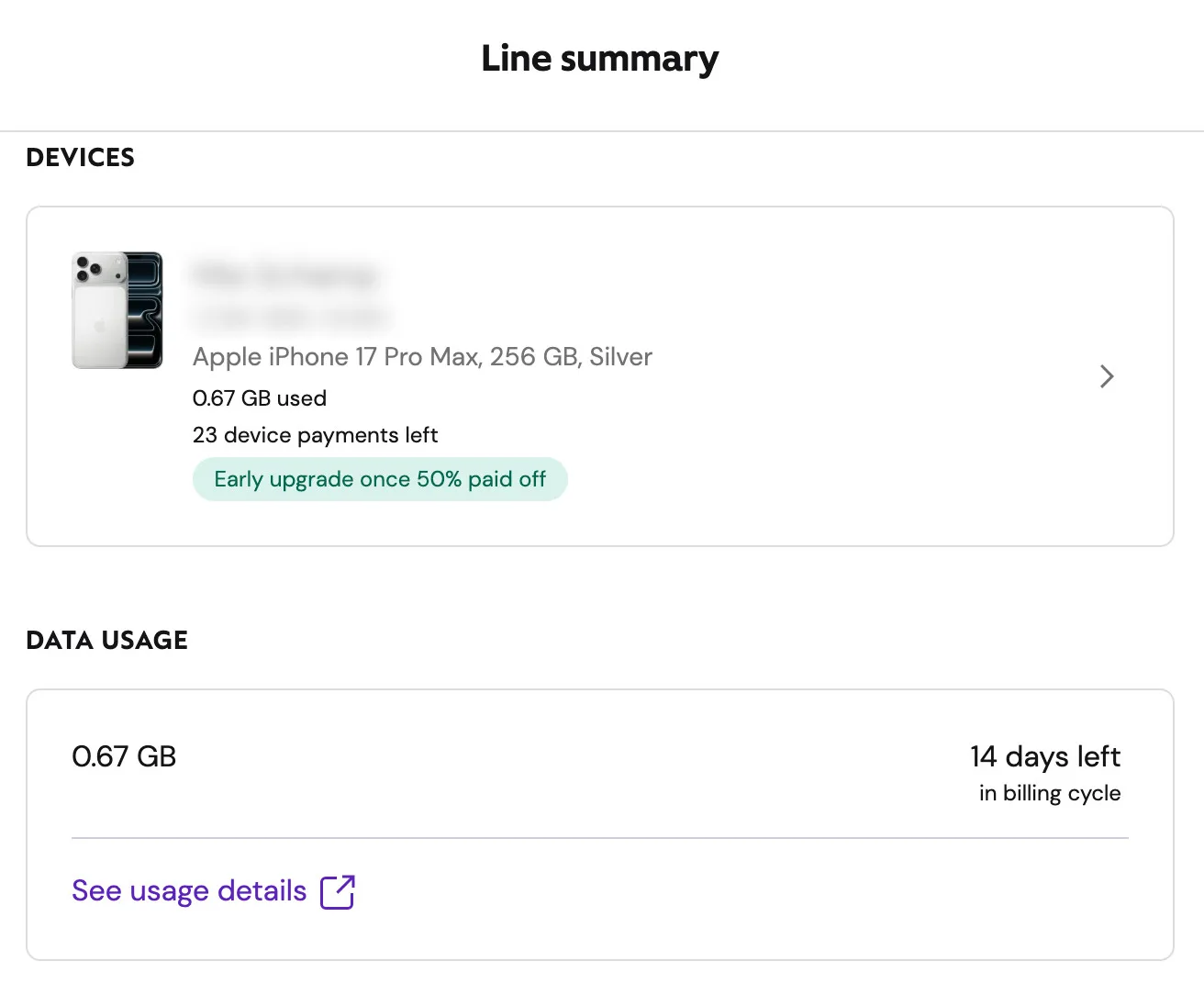
In everyday use, the data cap has been more than sufficient. Since Xfinity Mobile relies heavily upon Wi-Fi when available— especially at home—much of my daily usage never counts against cellular data at all. Streaming, app updates, and calls typically happen over Wi-Fi, which helps stretch mobile data much further than expected. I’ve got 14 days left in the billing cycle, and I’ve only used 0.67GB thus far. (And I am constantly on my device.)
For families or heavier users, the 50GB premium data cap on the Mobile Select plan feels more reasonable than restrictive. As long as you’re not relying exclusively on cellular data for everything, it’s easy to stay within the plan’s limits since it defaults to Wi-Fi before it uses cellular data. And when usage does approach the threshold, the app provides clear notifications, making it simple to adjust habits or upgrade plans if needed.
Buying or upgrading phones through Xfinity Mobile
Xfinity Mobile makes it easy to buy a new phone or upgrade your current device. You can also bring your own phone to the party; you just need the IMEI to check compatibility.
Customers can purchase devices outright or finance them over time, with a great selection of the latest phone models from manufacturers including Apple and Samsung. Trade-in options are also available, which can significantly reduce upfront or monthly costs depending upon the device and promotion. I went from an iPhone 15 Pro Max to an iPhone 17 Pro Max for around $2-something per month.
From personal experience, the upgrade process has been straightforward. Trading in an older phone and moving to a newer model was handled entirely through the Xfinity app and account portal, with mostly clear instructions and transparent status updates along the way. (I did have questions over how to send in my trade-in device, but it was resolved in a phone call.)
The new phone arrived in about four days, which is about what I expected. Activation was simple, and transferring service to the new device didn’t require a store visit or extended downtime. I just needed to make one call to AT&T to get a phone number transfer PIN because I opted to keep my number. Once that part was completed, the number was ported over in a span of about 10 minutes.
Buying (and upgrading) phones through Xfinity Mobile feels straightforward and convenient. While you won’t find the same volume of flashy promotions as some major carriers, the process is easy to navigate and integrates smoothly with the rest of the Xfinity ecosystem.
For customers who value simplicity and don’t want to juggle third-party retailers or separate financing, buying your new phone or upgrading through Xfinity Mobile represents a practical and low-friction option.
What do real Xfinity Mobile customers think?
In this year’s customer satisfaction survey, Xfinity Mobile once again overperformed for a provider that relies heavily upon app-based user management and online support.
- 82% of Xfinity Mobile subscribers were fully or highly satisfied with their service.
- 72% of respondents felt satisfied with the cost of their internet and cell phone service.
- 77% of surveyed customers said they found it easy to resolve an Xfinity Mobile customer service issue through Xfinity.

We always use [Xfinity] high speed internet. We like it for our cell phones and the video games.
No outages, reliable service, and many features, and the price and the WiFi [provides a] good signal always—my phone or Roku never lag.
They are hands down the best at everything, cable internet, and mobile.
From my own experience, I’ve had very limited need to contact Xfinity Mobile customer support, which is generally a good sign. I’ve only called support once, and the call was to get clarification on exactly how to send in my trade-in device after purchasing a new device for use after switching my service to Xfinity Mobile. While I initially expected a shipping label to be included in the box, getting the correct instructions took just a quick phone call, and the issue was resolved without the need for back-and-forth or escalation. That’s a win!
I haven’t personally needed to visit an Xfinity retail store for mobile service, since everything I’ve needed (from upgrading my phone to managing my account) has been handled via the Xfinity app and website. That said, I love the fact that there are nearby physical store locations that I could visit if the need arose. I’ve never felt comfortable with mobile providers that operate entirely online. I appreciate having the option of an in-person option if a more complex situation arises.
That’s actually quite notable for a provider that relies heavily upon app-based user management and online support. Between retail locations, online chat, and phone support, Xfinity Mobile offers multiple paths for finding the help you need, and most users seem to find a resolution to their issues without excessive friction.
Overall, Xfinity Mobile offers multiple support channels, such as app-based tools, online chat, support by phone, and at its retail locations. The app alone is very comprehensive and combines customer service for all Xfinity service offerings, making it so that there’s very little need for human-based support at all. From my own experience, most issues are handled via the Xfinity app and when more help is required, it’s just a phone call, chat or store visit away! I call that convenient, not frustrating.
Final take: Xfinity Mobile offers solid, competitive wireless service
Xfinity Mobile delivers precisely what it promises: affordable wireless service with reliable coverage, aimed at customers who already have an Xfinity Internet subscription and wish to bundle. In an everyday average use scenario, it holds up well for calls, texts, cellular data, and device management. You don’t have the complexity and high costs that are so often associated with major carriers that have post-paid billing. Compared to my previous provider, AT&T, the overall experience has been vastly more cost-effective, and I didn’t feel as though I needed to compromise on any of the factors that most impact my user experience.
That said, Xfinity Mobile is not meant for everyone. It makes the most sense for customers who are first and foremost comfortable bundling services and do not require premium carrier perks or major plan customizations. For existing Xfinity Internet customers who want to lower their wireless bill while maintaining dependable service, Xfinity Mobile is apt to be a very practical choice.
Xfinity Mobile review FAQ
Does Xfinity Mobile charge extra for 5G?
Xfinity Mobile does not charge extra for 5G service. 5G Nationwide and Ultra Wideband 5G coverage are included for free with all Xfinity Mobile plans.
Is Xfinity Mobile good?
Xfinity Mobile offers good performance for a smartphone provider. Customers with 5G devices will have fast download speeds on Xfinity Mobile, and you won’t be locked into a contract for Xfinity Mobile service.
What network does Xfinity Mobile use?
Xfinity Mobile uses Verizon’s cell phone network, which offers nationwide coverage in the U.S. along with international roaming access.
What is Xfinity Mobile?
Xfinity Mobile is Xfinity’s cell phone service. Xfinity internet customers can bring their smartphones to Xfinity and get cell service for their entire family.
Why you should trust us
To evaluate Xfinity Mobile’s plans, we spent several weeks analyzing its plans and pricing compared to competitors like Spectrum Mobile and Optimum Mobile. We also surveyed thousands of real-life customers as part of our customer satisfaction survey series to see what they felt about Xfinity Mobile.
Contributing writer Mia Carter has also been an Xfinity Internet customer for more than two years and recently upgraded to bundle Xfinity Mobile services. She drew upon this experience when researching and writing her Xfinity Mobile review. Check out our How We Rank page for more information on our methodology.
